 UniSZA ID
Kaedah pengajaran/penyeliaan dan penilaian
Perincikan dan jelaskan strategi perancangan dan pelaksanaan yang dilakukan terhadap perkara berikut:
- Pengajaran / penyeliaan
- Penilaian
Sertakan bahan bukti / maklumat yang berkaitan dengan pernyataan strategi di atas, contoh:
- Senarai kursus
- Rangka kursus dan bilangan pelajar
- Bilangan pelajar diselia mengikut peringkat Sijil / Diploma / Sarjana Muda / Sarjana / PhD
COURSES I (CO-) TEACH
There are three courses that I teach throughout the years for the Bachelor of Medicine & Surgery (MBBS) programmeat the Faculty of Medicine. It involves 60 students for all the three courses.
1. BMM 42304 (Family Medicine),
2. BMM 42910 (Peripheral Medicine)3. BMM 53804 Medical Ethics & Profesionalism
1. FAMILY MEDICINE COURSE
The Family Medicine course is a 4-hour credit course, run in 4 weeks. It is co-taught mainly by 6 lecturers in which each lecturer takes several topics, which include lecture, seminar, tutorial, practical and clinical session. The course involves 4 groups of students in each session, in which there are 15 students in each group. Each group receives the same teaching and learning activities based on the deatiled course information. The course content is supported with KeLIP and other platforms e.g. Padlet where all the materials are uploaded in the platforms.
The Course Learning Outcomes for Family Medicine are for the students to be able to:
1. Solve common health problems in primary care.
2. Discuss entrepreneurial skills in healthcare services.
3. Demonstrate the use of digital skills in promoting disease prevention.
4. Conform to ethics and professionalism in managing patients in primary care.
The T&L activities include lectures, seminar, scenario based discussion, clinical teaching, practical sessions.
My classes for this course are:
1. Lecture: Diagnostic strategy in Primary care
2. Approach to chronic disease in primary care
3. 2 sessions of clinical teaching
4. 1 session of practical class.
The lecture sessions are taught using flipped classroom approach where students are expected to watch a total 8 short videos (about 5-7 minutes each), supported by animation videos to reflect clinical application prior to class. Students are then expected to do formative assessment to assess their understanding. All the materials are provided in KeLIP and Padlet. During class, we will summarise and discuss the content of the lecture, supported by a role play. In addition, there is an interactive platform in Padlet for student and teacher to discuss or ask questions.
For clinical teaching, a video on clinical consultation is provided so that students can understand the skills of consultation, for them to practice with real patient in a clinic setting.
Aktiviti Pembelajaran: Family Medicine Course
PADLET PLATFORM FOR MY TEACHING SESSIONS
Family Medicine Posting Padlet: Digital Learning and Student Engagement Platform
To support student-centred learning and the flipped classroom approach in the Family Medicine posting, I developed and curated a dedicated Padlet as a central online learning platform for MBBS students. The Padlet serves as a structured repository of learning materials, communication tools, and interactive activities that students can access before, during, and after face-to-face teaching sessions.
The Padlet is organised into several thematic sections. It begins with introductory columns such as Ice Breaking: Me and Ice Breaking: You, which foster rapport between the lecturer and students and encourage social interaction at the beginning of the posting. The Our Class section provides essential information regarding schedules, learning activities, expectations, and instructions for students.
Core academic content is organised into dedicated sections covering important Family Medicine topics, including General History Taking, Approach to History Taking for Acute Presentations using the Safe Diagnostic Strategy, and Approach to Chronic Disease Management. These sections contain short instructional videos, lecture notes, and supplementary learning resources designed to facilitate self-directed learning prior to classroom discussions.
Additional learning materials include seminar resources, lecture slides, and problem-based question (PBQ) exercises that promote clinical reasoning and application of knowledge in authentic primary care scenarios. Students are encouraged to engage actively with the materials, complete assigned tasks, and participate in discussions through comments and responses within the platform.
The Padlet supports Outcome-Based Education (OBE) principles by aligning learning resources with course learning outcomes and encouraging active, reflective, and collaborative learning. It also enhances accessibility by providing students with a single, organised platform for course materials, thereby improving learning continuity and preparation for clinical practice. Overall, the Padlet functions as an effective digital learning environment that complements face-to-face teaching and promotes learner engagement throughout the Family Medicine posting.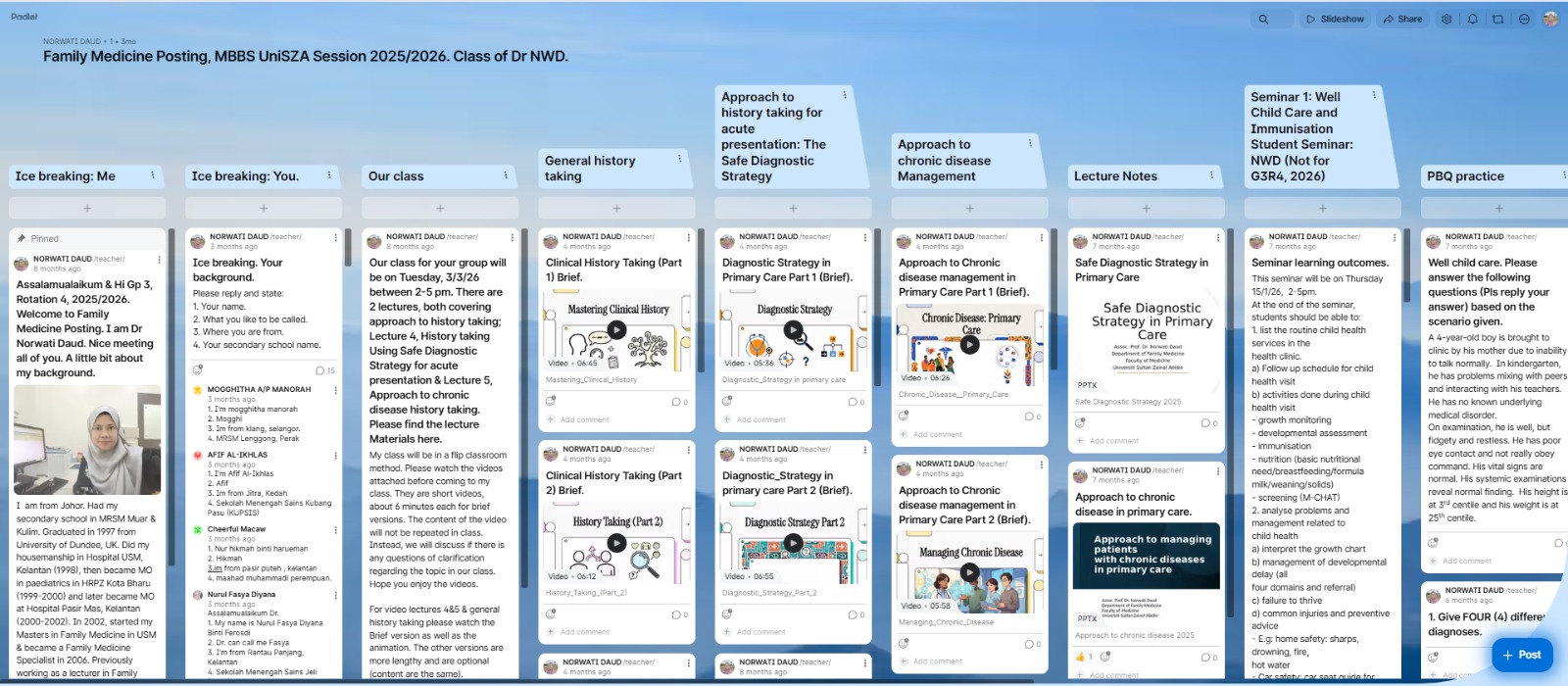
Two lectures that i am teaching in this course is:
Lecture 1: Safe diagnostic strategy in primary care
Lecture 2: Approach to chronic disease.During the early yaers of 2015, I was using the traditional method of using PowerPoint slides to deliver my lecture. Following that, with the availability of more applications and tools, i use other presentation tools such as Prezi and slide deck. Subsequently, I convert my approach to flipped classroom and change my slides into a video lecture. Coming to 2020s, I use more of other applications to deliver my lecture. As complimentary, I use video lecture, animation and the latest one is audio podcast using notebookLM.
Lecture 1: Safe diagnostic strategy in primary care
Lecture 2: Approach to chronic disease
Use of Scratch Animation for Teaching Clinical Reasoning in Family Medicine
To enhance students’ understanding of clinical reasoning and patient assessment in primary care, I developed and incorporated animated learning resources using the Scratch platform. These animations are used to support lectures on Approach to Acute Symptoms Using the Safe Diagnostic Strategy and Approach to Chronic Disease History Taking. Scratch is an interactive animation platform that enables the creation of visual stories, simulations, and educational scenarios, making abstract clinical concepts easier to understand and apply.
The animations simulate authentic primary care consultations, guiding students through a step-by-step approach to history taking and diagnostic reasoning. In the acute symptom module, students are introduced to a structured diagnostic strategy that emphasizes identifying red flags, considering differential diagnoses, assessing severity, and making safe management decisions. Through animated patient encounters, learners observe how clinical information is gathered, interpreted, and synthesised to arrive at an appropriate working diagnosis.
In the chronic disease history-taking module, the animation demonstrates a comprehensive and patient-centred approach to assessing long-term conditions. The scenario highlights exploration of presenting concerns, disease progression, treatment adherence, complications, psychosocial factors, and preventive care considerations. Visual cues, dialogue, and sequential decision-making processes help students appreciate the holistic nature of chronic disease management in primary care.
The use of animation promotes active learning, maintains student engagement, and supports the flipped classroom approach by allowing students to review complex clinical processes at their own pace. By visualising real-life consultations and clinical reasoning pathways, these resources help bridge the gap between theoretical knowledge and practical application, ultimately strengthening students’ diagnostic thinking and consultation skills.Diagnostic Stategy Part 2
Chronic disease Part 1 & 2: Audio podcast
TEACHING METHOD: Experiential learning
Experiential Learning in Family Medicine Teaching
In my Family Medicine teaching, I apply experiential learning to expose students to authentic work-based clinical environments. Students learn through direct observation and participation in real patient care activities within healthcare facilities, allowing them to understand how doctors assess, manage, and communicate with patients based on real clinical problems. Before entering real clinical settings, students practise using simulated patients in the skills laboratory or healthcare facility. This enables them to develop consultation, history-taking, clinical reasoning, and communication skills in a safe and supportive environment. Formative feedback is provided during practice sessions, allowing students to improve progressively until they gain confidence to perform independently.
At the initial part of the training, a simulated patient is used either in the skills lab or in real healthcare facilities. During this session, the student can practice their skills and formative feedback can be given to student on his/her performance. Practice is done until he/she is confident to do it independently.
In some cases, to achieve the course learning outcome, a project in health facilities is designed for students to learn specific topics. in this project, not only do the students learn about factual knowledge, but they can straight away practise on real patients. This project also aimed to improve their affective skills.
MODULES & GUIDEBOOK
All activities are presented in a proper guidebook so that students are clear on the topics, objectives and outcomes that they are expected to learn. These materials were developed to ensure students get the same instructions, materials and content.
AUTHENTIC ASSESSMENT
Authentic assessment is used in our course. Students are assessed on their cognitive, psychomotor and affective skills using real patients in a real work setting. this method can ensure that students are able to grasp all the skills needed later when they are working.
BMM 42910 Peripheral Medicine: CARE posting
CARE (Peripheral Medicine) Posting Padlet: Digital Learning Platform for Clinical Education
To support teaching and learning during the CARE (Peripheral Medicine) posting for Year 4 MBBS students, I developed and curated a dedicated Padlet as a comprehensive digital learning platform. The Padlet serves as a central repository for learning resources, clinical guidance, announcements, and student engagement activities throughout the posting. It was designed to promote self-directed learning, facilitate blended learning, and enhance students’ clinical preparedness before and during their peripheral hospital attachments.
The Padlet is organised into thematic sections that provide easy access to posting objectives, schedules, assessment information, learning outcomes, and essential clinical resources. Educational materials include lecture notes, clinical guidelines, videos, case discussions, reflective learning activities, and links to evidence-based resources relevant to common medical conditions encountered in peripheral healthcare settings. Students are encouraged to review the materials before clinical sessions and use them as references during ward-based learning activities.
Interactive features within the Padlet support collaborative learning through discussion boards, case reflections, question-and-answer activities, and sharing of clinical experiences from different training sites. The platform also enables continuous communication between students and lecturers, ensuring timely dissemination of information and feedback.
The Padlet aligns with Outcome-Based Education (OBE) principles by supporting the achievement of programme learning outcomes related to clinical reasoning, patient management, professionalism, communication skills, and lifelong learning. By integrating digital resources with workplace-based clinical experiences, the Padlet enhances student engagement, encourages reflective practice, and promotes meaningful learning within authentic healthcare environments. It has become an important component of the CARE posting, providing students with a flexible, accessible, and learner-centred educational experience.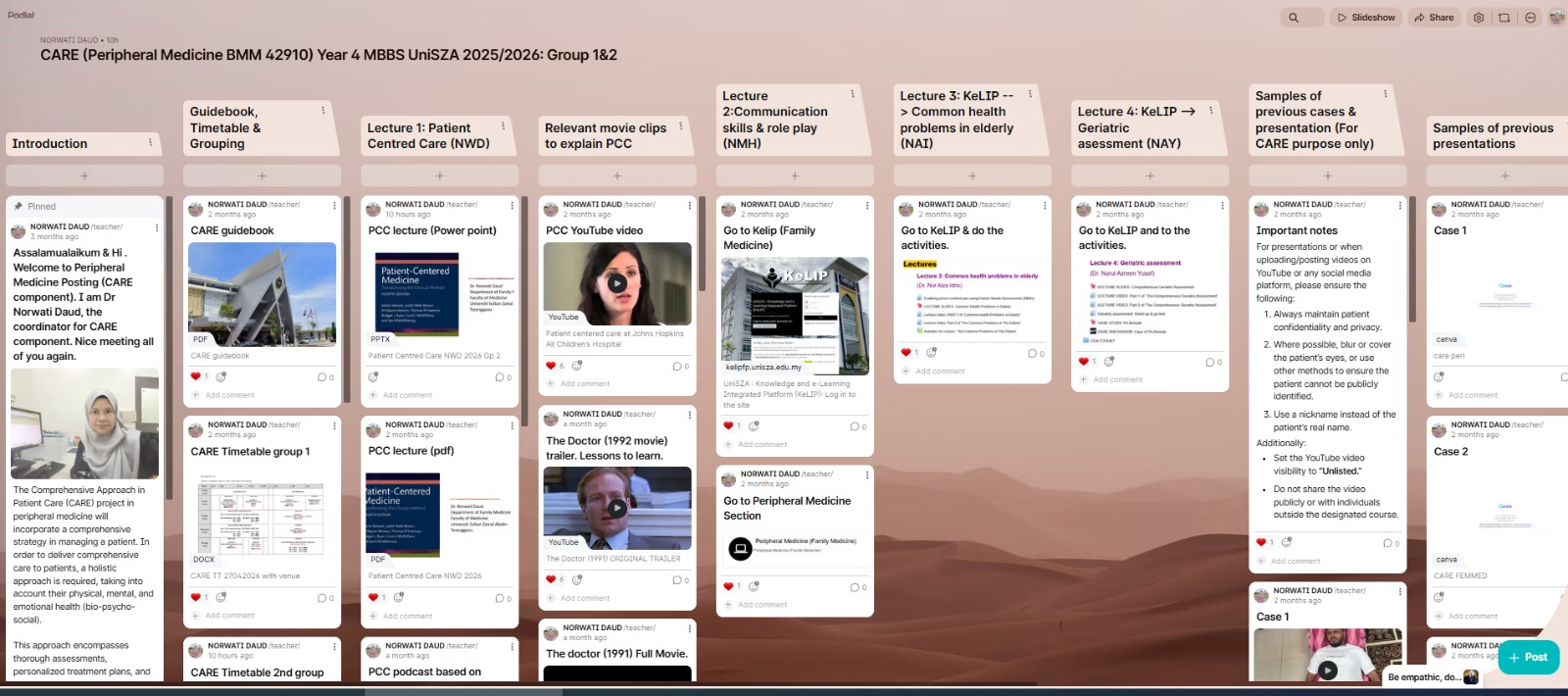
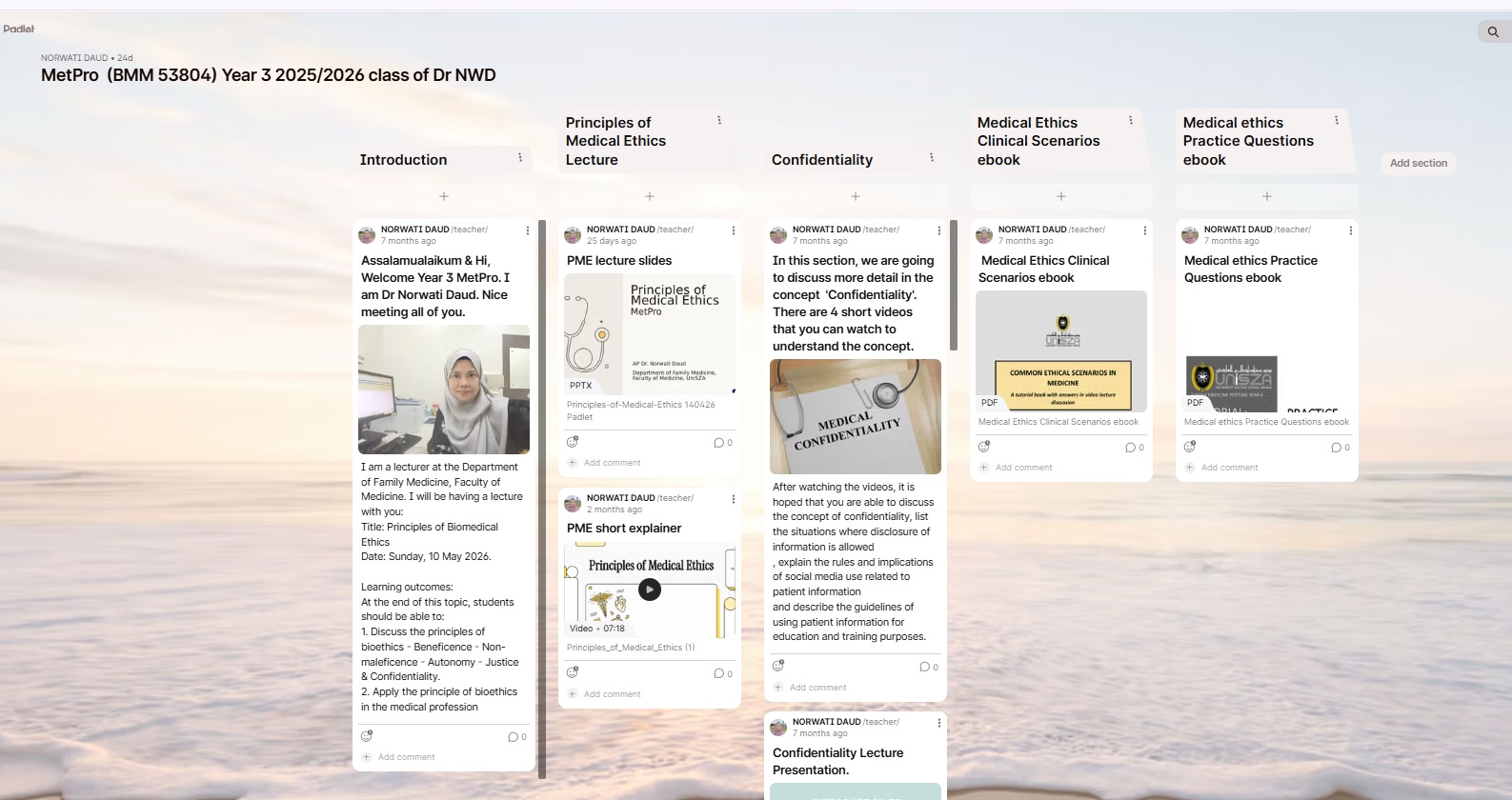
BMM 53804 MEDICAL ETHICS & PROFESSIONALISM
Resources for Lecture 2: Principles of Medical Ethics
Animation is used using Scratch applications to show the clinical application of my lecture.
https://scratch.mit.edu/projects/919591491/embed
The use of complimentary audio podcast using NotebookLM.
1. Diagnostic strategy Part 1